About Roger

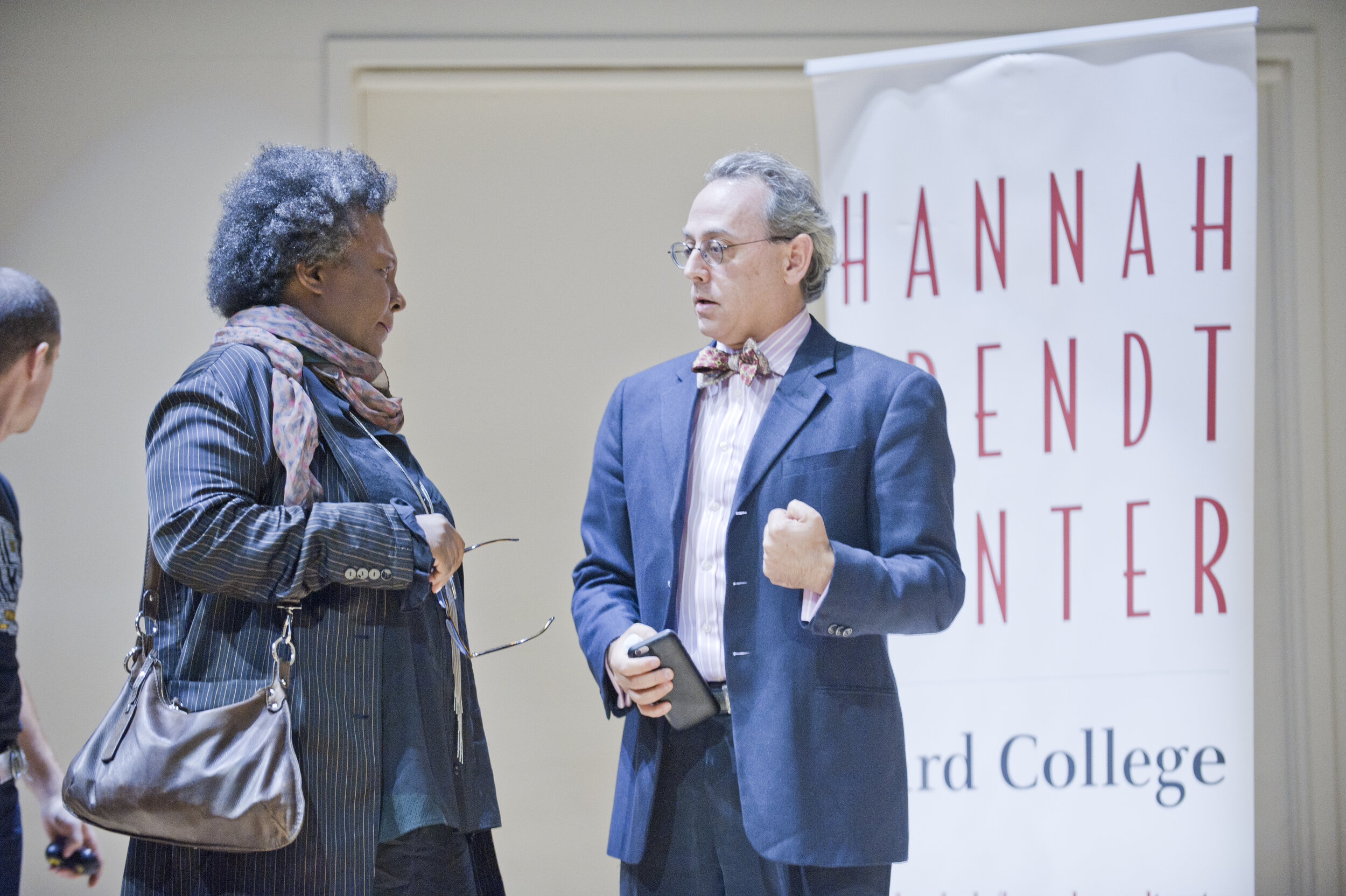
Roger Berkowitz is founder and academic director of the Hannah Arendt Center for Politics and Humanities at Bard College, where he teaches Politics, Philosophy, and Human Rights.
Roger teaches a weekly online reading group on Arendt, hosts the podcast Reading Hannah Arendt with Roger Berkowitz, and is a regular panelist on WAMC’s The Roundtable, the NPR affiliate in Albany, NY. He writes the weekly Amor Mundi newsletter, edits the annual HA: The Yearbook of the Arendt Center, and hosts many public events including the annual Arendt Forum.
Roger's latest book is A World We Share: Hannah Arendt and the Power of Friendship in a Broken World, available directly from Yale University Press or through major retailers such as Amazon. The audiobook is also available here.
He is the author of The Gift of Science (Harvard), past editor of the series Just Ideas (Fordham), and co-editor of the series “Thinking With Arendt” (De Gruyter). His edited volumes include Tribalism and Cosmopolitanism (De Gruyter), The Perils of Invention: Lying, Technology and the Human Condition (Black Rose Books), Thinking in Dark Times: Hannah Arendt on Ethics and Politics, and Artifacts of Thinking: Reading Hannah Arendt's Denktagebuch. For Library of America, he wrote the introductions to On Civil Disobedience: Henry David Thoreau and Hannah Arendt and the forthcoming On Totalitarianism.
His writing has appeared in The New York Times, The American Interest, Bookforum, The Los Angeles Review of Books, Public Seminar, Salmagundi, Philosophie Magazine, Democracy: A Journal of Ideas, The National Review, and many other publications.
Berkowitz is the recipient of the Heinrich Boll Foundation’s 2019 Hannah Arendt Prize for Political Thought and Con-solatio’s 2024 Compassion Prize.
Roger’s Books
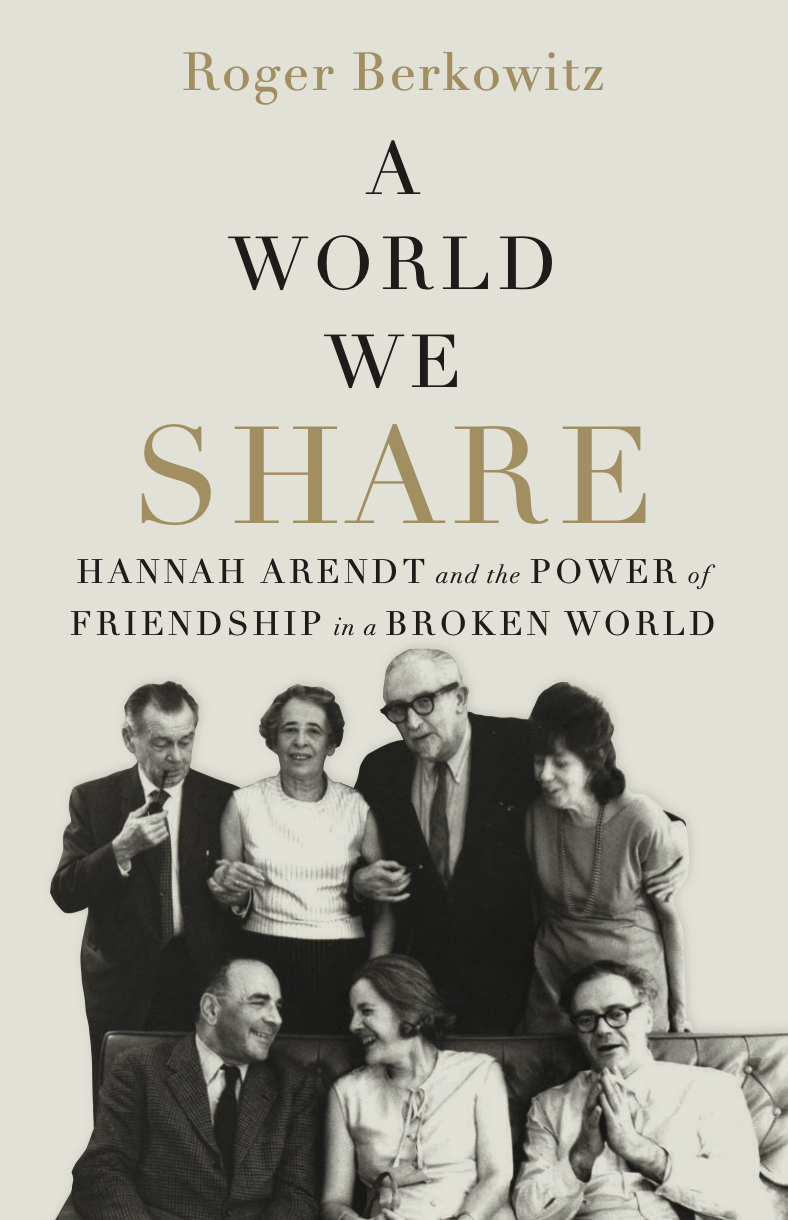
A World We Share: Hannah Arendt and the Power of Friendship in a Broken World
A bold rethinking of politics through Hannah Arendt’s life and thought, arguing that friendship—not truth—is the fragile but necessary foundation of democratic life
A World We Share sounds the warning that politics cannot be saved by truth alone. Against a tradition that elevates truth above all else, Roger Berkowitz draws on the life and thought of Hannah Arendt to argue that a politics governed by an objective ideal of truth becomes cruel, coercive, and ultimately anti-political. Friendship—grounded in dialogue, respect, and plurality—offers a more human political bond.
Hannah Arendt (1906–1975) was known to possess a “genius for friendship.” A Jew in Nazi Germany, an exile in Paris and New York, and an uncompromising critic of postwar orthodoxies, she survived and flourished through friendships that were intellectually intense, complicated, and morally demanding. Her tribe of outsiders included thinkers as disparate as Karl Jaspers, Hans Jonas, Mary McCarthy, Gershom Scholem, Heinrich Blücher, and Martin Heidegger.
This book explores how these friendships shaped Arendt’s political thinking. Berkowitz weaves Arendt’s life, thought, and friendships into a powerful meditation on our present moment. In an age of mass loneliness, ideological certainty, and civic breakdown, A World We Share connects democracy not to consensus or moral purity but to our capacity to maintain relationships with others we do not agree with—and cannot fully understand. Berkowitz argues that our political crisis is actually founded in a crisis of friendship. Only by nurturing private and also public friendships can we reimagine a truly democratic politics.
Available directly from Yale University Press or through major retailers such as Amazon. The audiobook is also available here.
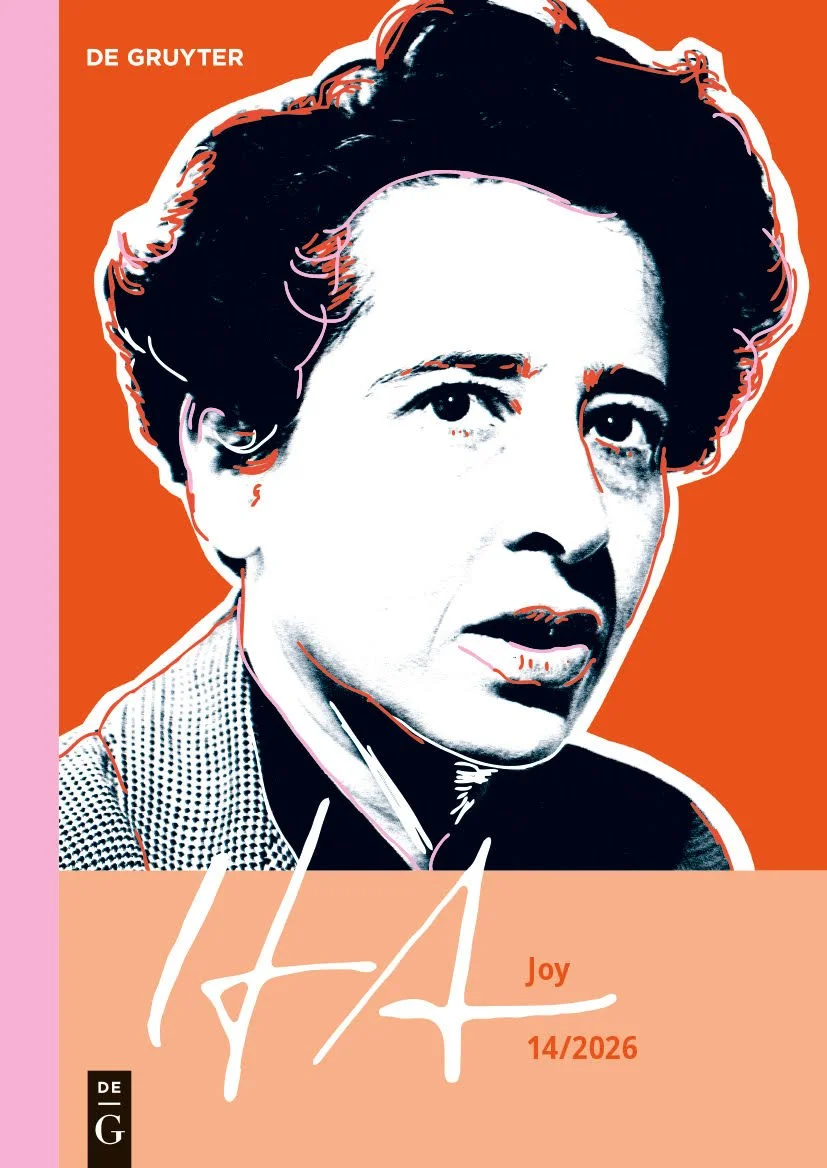
HA: The Yearbook of the Hannah Arendt Center for Politics and Humanities, Volume 14: Joy
How can we experience joy in dark times, and what does it mean to truly love the world amidst suffering, injustice, and uncertainty? This volume, based on the Hannah Arendt Center’s 17th annual fall conference, explores joy as a complex and vital force. Drawing on philosophy, literature, the arts, and lived experience, contributors examine how joy differs from happiness, how it can foster resilience, and how it connects us to meaning beyond ourselves. Engaging with Arendt’s concept of Amor Mundi, the book offers a rigorous, timely exploration of joy as both ethical and existential practice, providing scholars and students with new insights into human flourishing and the cultivation of hope in fractured times.
Available directly from De Gruyter Brill.
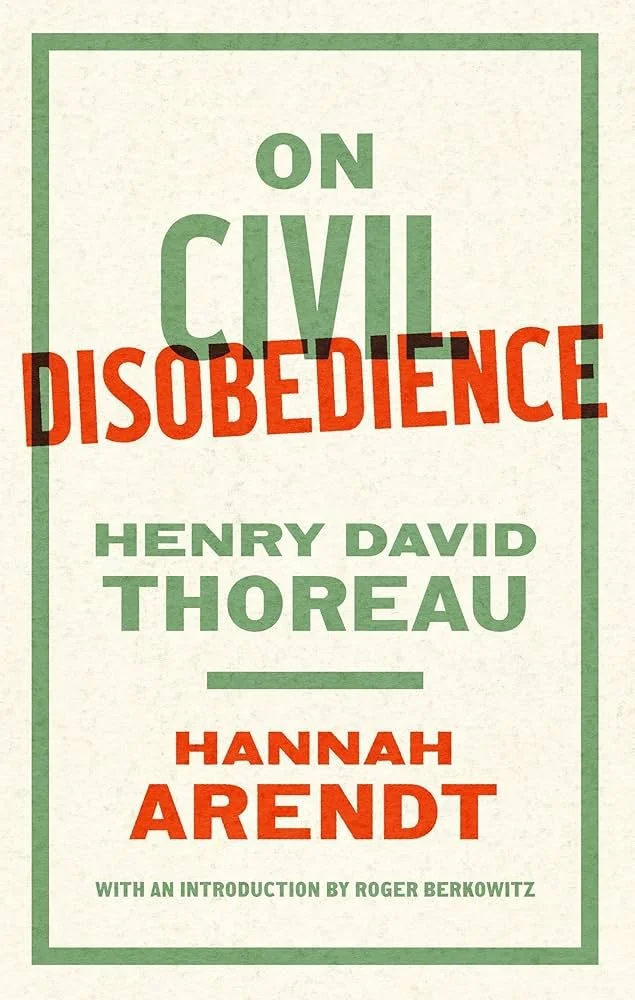
“If… the machine of government… requires you to be the agent of injustice to another, then, I say, break the law. Let your life be a counter friction to stop the machine.”
— Henry David Thoreau
“Dissent implies consent, and is the hallmark of free government; one who knows that he may dissent knows that he somehow consents when he does not dissent.”— Hannah Arendt
Published in 2024, On Civil Disobedience is available now at your local bookstore or preferred retailer.

The Gift of Science


New & Noteworthy
Hannah Arendt and why friendship matters more than truth
Published in the Financial Times, October 2026.
In a polarised age, the political theorist’s notion of civic fellowship is essential
Hannah Arendt argued that friendship matters more than agreement in politics. Drawing on Arendt’s letters, friendships, and political thought, Roger Berkowitz explores why truth and facts alone cannot sustain a shared democratic world. From political polarization and bitter personal disagreements to the limits of tolerance, Berkowitz makes the case for civic friendship: the difficult work of understanding those with whom we disagree, while recognizing when actions cross a fundamental moral boundary.
Roger Berkowitz’s TEDx talk, Speak Your Mind: Why Free Speech and Listening Matter
Presented at TEDxBard College, June 2025.
The TEDx Talks description of Roger’s TEDxBard College talk notes that it “argues that democracy thrives on open dialogue and the exchange of differing viewpoints, rather than a commitment to facts or to truth. Drawing on Hannah Arendt’s philosophy, he emphasizes that politics is about persuasion, understanding, and civic friendship—where even those who disagree engage in meaningful conversation to build a common world together.”
The World in Time, A Broken World: Roger Berkowitz and Jennifer Szalai
“Friendship is an enormous part of my life, and it was an enormous part of Arendt’s life,” Roger Berkowitz says on this week’s episode of The World in Time. “She was said to have a genius for friendship by her friends. She was an exile, stateless for eighteen years, and she really did come to believe that friendship is what she called a ‘homeland.’ She didn’t think of herself as German, or Jewish, or American, or European. She said, ‘The only people I love are my friends.’ Friendship is hard, and she uses this beautiful metaphor. She says, ‘Friendship exists on the knife’s edge.’”
Hannah Arendt was controversial in her own times. She remains controversial in ours. In her own times, the controversies sometimes tested Arendt’s friendships. Or shattered them. This series of conversations, A Broken World, attempts to make sense of both Arendt’s broken world and our own, and it addresses the controversies around her work by doing what every issue of Lapham’s Quarterly does—pluralize the voices.
In this second episode in the series, Donovan Hohn speaks with Jennifer Szalai, essayist and nonfiction book critic for The New York Times, about her article “Hannah Arendt is Not Your Icon,” and with Roger Berkowitz, academic director of the Hannah Arendt Center, about his new book, A World We Share: Hannah Arendt and the Power of Friendship in a Broken World, which examines the nature of friendship through the lens of Arendt’s biography and her thinking on the subject. On the unabridged, paywalled edition of the podcast available on the Lapham’s Quarterly Substack, Berkowitz and Hohn turn to the present-day implications of Hannah Arendt’s controversial essay “Truth and Politics,” first published in The New Yorker in 1967.
The Dispatch, ‘Friendship on the Knife’s Edge’ | Interview: Roger Berkowitz
Notorious misanthrope Jonah Goldberg is skeptical of the power of friendship in politics. Winning him over will be no easy task, but if anyone is up to the job, it’s friend of the Remnant and Hannah Arendt scholar Roger Berkowitz. Listen in as Roger and Jonah duke it out over friends, enemies, Zionism, the Nazis, fear of the people, facts, truth in politics, Alexis de Tocqueville, Madisonianism, local governance, the distribution of power, and much more.